Smart Farming / Integration brief

Fertigation system controls that fit the site brief

Define the monitoring and automation requirements before comparing controller packages. A connected interface is useful when the field measurements, communication coverage and operator responsibilities are understood.

Review system inquiry options
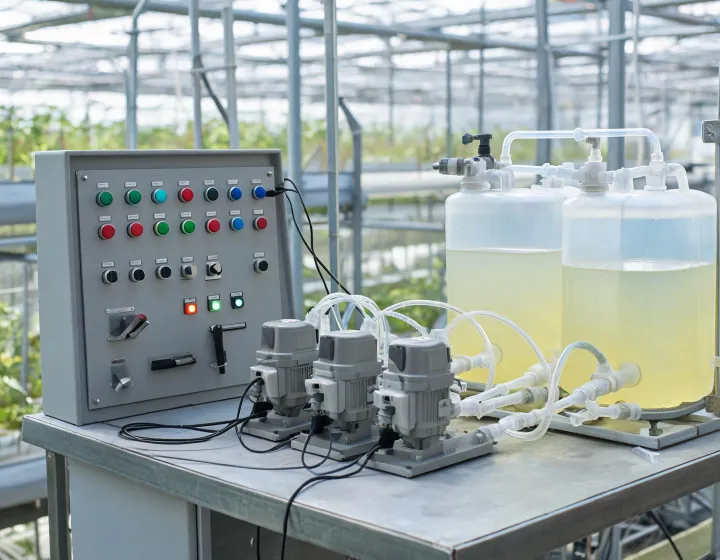
Fertigation controller with sensors and nutrient tanks in a greenhouse

Three interfaces to make explicit

Measure at a defined point

Specify flow meter location, pressure measurement and EC/pH probe placement. Ask for sensor ranges, calibration fluids, replacement intervals and a sample data record. A reading has limited value if its units or collection point are ambiguous.

Connect with an agreed protocol

Identify controller inputs, valve outputs, power and the required communication interface. Request the actual protocol documentation and clarify which integration work belongs to the supplier or installer. Avoid assuming a platform label establishes compatibility.

Define safe fallback operation

Document the intended action after a sensor fault, communication outage or interrupted power. Local manual control may help maintain operation, but the response logic and restart procedure need review for the exact installation.

Discuss integration requirements

Validate the connection in stages

This is a proposed procurement verification sequence, not a product development history or a claim of completed deployments.

  1. Freeze interface requirements

    List supply voltage and frequency, dry-contact or analogue signals, network availability and the number of dosing channels. Specify system flow rate in gpm or m³/h and operating pressure in psi or bar for each relevant zone state.

  2. Request a bench demonstration

    Ask the factory to identify the demonstration controller and firmware, simulate a signal change and show the resulting valve or pump action. Record timestamps, settings and alarms. Confirm any paid demonstration or sample terms before arranging the check.

  3. Agree site acceptance evidence

    Before commissioning, define who measures delivered dosing quantity, checks probe calibration and signs off failure recovery. Use the actual source water and expected flow range; a successful bench connection alone does not validate nutrient distribution through field pipework.

Resolve the trade-offs before adding features

Timer or feedback control?

A timer package may suit a repeatable duty with manual checks. Feedback control can respond to measured conditions but depends on calibration and operating logic. Compare sensor upkeep, dosing channels and operator training with the stated budget rather than equating automation with better crop outcomes.

Cloud or local access?

Remote access adds visibility where connectivity supports it; local control reduces reliance on an external connection. Ask about offline behavior, data export, access permissions, recurring charges and support terms. No platform or subscription is included unless named in the offer.

Drip or pivot integration?

Drip irrigation emitter demand and center pivot operating patterns create different hydraulic conditions. Require the designer to confirm injection location and operating range. More telemetry cannot correct unsuitable filtration, a mismatched injector or an unreviewed fertilizer mix.

Premium preferences can prioritize integration support and data access; mid-range options can retain essential alarms; budget-focused configurations may reduce sensors. Compare each alternative against mandatory safety, compatibility and maintenance requirements. These are evaluation choices, not supplier ratings.

Specify the control problem

Tell us the measurements, dosing channels and interfaces you need to coordinate. Include the project quantity, US destination and commissioning boundary.

  • Existing controller and input/output details
  • Power and network availability
  • Manual fallback and alarm expectations
  • Optional budget and supplier preference