-
Where a Wrong Injector Shows Up First
-
What a Fertigation Injector Actually Does
-
Batch Injection and Continuous Feed Are Different Jobs
-
Power at the Site Decides the Injector Type
-
Sizing Injection Rate From the Zone, Not the Catalog
-
Questions to Settle Before You Compare Models
-
Is Bigger and More Precise Actually Safer
Picture two vegetable blocks, same tape, same water, same fertilizer program. On the first farm the injection cycle fits inside the irrigation window: the pump shuts off, the fertilizer is already in the line, and the crew moves to the next set. On the second, the injector cannot finish in time, or the power available at the pad does not match the unit that arrived, so the set runs long, gets split across two irrigations, or waits for another day.
The difference is rarely the price tag. It comes down to two facts a grower already owns before shopping: what the injection duty is, and what power exists at the injection point. A flow rating on a spec sheet sorts the survivors later; it does not pick the winner.
Where a Wrong Injector Shows Up First
What shows up first is not a broken part. It is a schedule that stops fitting. Suppose a block has an injector sized or powered so the fertilizer job takes longer than the set lasts. Nothing fails, but the operator stretches the irrigation, splits the fertilizer into two passes, or pushes it to the next watering, and each of those fixes costs water, labor, and a timing that no longer matches the crop. That is the failure to design out at purchase, because fertilizer injection carries one hard scheduling requirement: the injector has to have enough capacity to complete the injection cycle in a reasonable period. Whether a given unit clears that bar depends on the window you actually run.
What a Fertigation Injector Actually Does
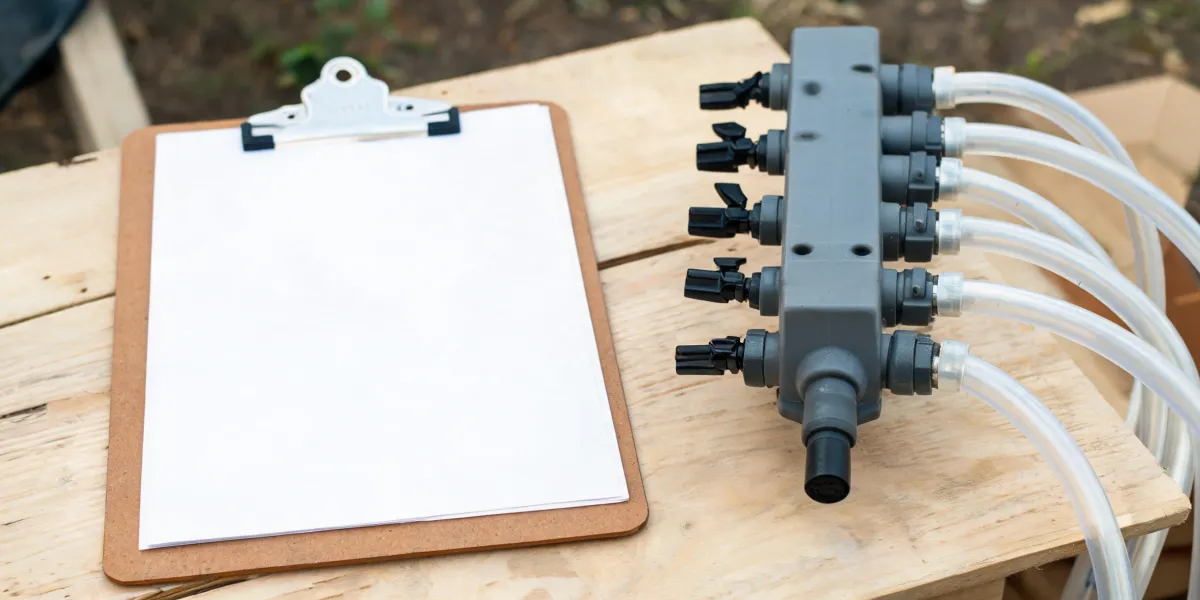
Strip it to the mechanism. A fertigation injector is a device that moves a concentrated fertilizer solution into the irrigation stream at a controlled rate, mounted between the water source and the zone, so the water carries the nutrients to the root zone. It works on the injection action, not on the recipe. That line matters, because the device cannot tell you what to inject or how much nutrient a crop needs — it can only meter whatever you put in front of it. How the parts around it are assembled, and which options make sense, depends on the size of the system, the water source, the crop, and how much automation you want. Those four inputs shape the configuration before any model number enters the conversation.
Batch Injection and Continuous Feed Are Different Jobs
Batch injection is a finish-the-job task. You have a volume to deliver and a window to deliver it in.
Continuous feed is a different animal.
When fertilizer goes in on a continuous basis, the injector runs for the whole irrigation event, and the question shifts from can it finish to does the rate hold steady hour after hour. That is why the accuracy requirement moves: for fertilizer, holding an accurate injection rate is not critical unless the fertilizer is injected continuously. In a batch job, an injector that drifts a little still delivers the volume, just unevenly across the set. In continuous feed the same drift is the whole story, because the concentration in the line is whatever the injector is doing at that moment. Same hardware family, different job, different line on the spec sheet. The chemical being injected is a key consideration in choosing an injector at all, which means a grower moving from a batch program to continuous feed should reopen the selection instead of assuming the old unit still fits.
Power at the Site Decides the Injector Type
Power is the second gate, and it closes harder than most buyers expect. The type of power available at the injection site will affect your choice of injectors, and the practical list is short: a gasoline engine, the PTO shaft of a tractor, an electric motor, or the water pressure of the irrigation system itself. The reason this belongs at the top of the page instead of the bottom is physics — pushing fluid into a pressurized line takes energy, and that energy has to come from something already at the pad. A unit whose drive does not match what you can supply is not a candidate at a higher price; it is not a candidate. Water-pressure-driven units live off the pressure differential the system already produces, electric units need the service and the shelter a motor wants, PTO units need the tractor present at injection time, and gas units need fuel and an engine that starts in the season you need it. Which of those is realistic on your farm is a fact about your farm, not about the pump.
Sizing Injection Rate From the Zone, Not the Catalog
Sizing comes after duty and power, and it starts from your own numbers. The injection rate you need is the volume you intend to inject divided by the time you are willing to spend injecting, and both of those come off your irrigation schedule, not off a product page. If a set lasts a certain number of hours and you want the fertilizer in before the set ends, that division gives you a floor. Penn State Extension's guidance for vegetable drip production offers a scale reference worth reading carefully: an injector with a capacity of 1 gpm is likely to be sufficient for injecting fertilizer into irrigation zones of less than 10 acres. That figure is an example bound to that publication's conditions and crop context, not a rule that a slightly larger block automatically needs more or that the same figure suits every field of similar size, because the same guidance says the size of the system, the water source, the crop, and the degree of automation all shape what gets built. Treat the number as a sanity check on your own arithmetic, not a substitute for it.
Questions to Settle Before You Compare Models
Before comparing models, write down answers to a short set of questions, because each answer eliminates whole categories. What is going into the line — fertilizer alone, or fertilizer plus something else? Is the program batch or continuous? How long is the irrigation window, and how much of it can injection consume? What power exists at the pad: grid service, a tractor that is genuinely there during sets, fuel, or enough pressure differential to drive a unit? How large is the zone, and what is the water source? How much automation do you want, and who will be at the pad while the injector runs? Two more limits belong on the same page. This article does not supply fertilizer recipes, treatment doses, water or tissue test interpretation, or compliance conclusions — those come from your own lab work, your crop advisor, and the rules that apply to your operation. Get them elsewhere before you buy, not after.
Is Bigger and More Precise Actually Safer
The most common objection at the counter is that a bigger, more precise unit must be safer. Work it back to the two facts.
A larger flow rating does not fix a scheduling problem, because the constraint is the window and the plumbing around it, and it does not touch a power problem at all. Extra metering precision has the same shape: in a batch program the job is finishing the volume inside the window, which is why precision only starts to pay once injection is continuous. Where the objection genuinely holds is continuous feed, where rate stability is exactly what the money buys and the extra cost has a return.
So the split is not bigger versus smaller. Write down batch or continuous, and write down the power you can actually supply at the pad; if you cannot answer both, you are not ready to compare models, and if you can, the shortlist usually builds itself.