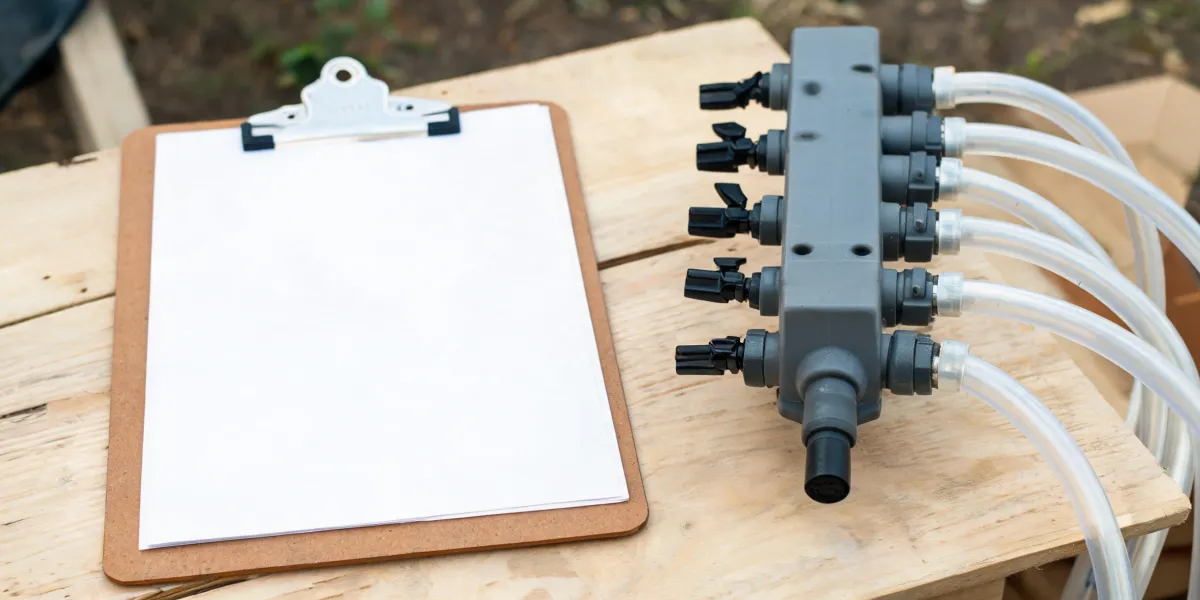
The injector gets ordered first. It is the piece with the spec sheet, the dial, the number that looks like a decision. The backflow device gets added later, once the plumbing is laid out, and that order is what turns a simple injection point into a re-plumbing job. A backflow or anti-siphon valve is necessary if the supply is a well or a municipal water source, or when fertilizers or chemicals are injected into the system.
Read those triggers again. The supply type is known on day one, before any injector exists, and injection is the purpose of the project. For a drip or high-tunnel block, the backflow device is not the accessory that finishes the system. It is the limit that decides what the fertigation system can be, and accuracy on the dosing side never gets to override it.
Why the backflow valve should come first
So what do growers get wrong when backflow protection is the last line on the fertigation list? They treat it as a finish detail on a system whose first condition it already satisfies. The device is a gate, not a decorative extra: it sits between the supply and everything you intend to connect, and its presence is what makes an injection point permissible in the first place.
The cost of the wrong order is not the valve. It is everything that has to move around it. A plan drawn without a device in it puts the injection point wherever the pipe happened to run. When the device has to be worked into that line ahead of the injection point, the layout and fittings can be reworked after the fact instead of settled on paper. Ask for the plumbing drawing before the injector quote, then trace where the injection point sits relative to the protective device. If the device is absent from the drawing, the quote is premature.
What fertigation means, and what it does not
What is fertigation as a piece of hardware, rather than as a nutrient program? It means metering material into a pressurized irrigation line through dedicated injection hardware. That is the whole definition, and it is narrower than the loose way the word is often used.
Two coupled decisions live inside it: protecting the water supply, where the backflow condition applies, and metering material into the flow, which is the injector's role. A fertigation package earns the name by answering both on one drawing. Judge it on that drawing, not on the size of the pump box in the photo.
What it does not cover matters just as much. It is not a nutrient recipe, not a dose schedule, not a compliance ruling, and nothing here supplies those. Local backflow requirements and chemical labels can attach conditions that a plumbing review will not surface, so the drawing and the label are what you check against, not an article.
Three injection jobs that need different hardware
Why does one injector not cover fertilizer, clogging chemicals and pesticides equally well? Because those three jobs do not fail the same way. Injecting chemicals to prevent clogging calls for an accurate and very low injection rate, and because those materials are usually fed continuously, a separate injector is often the practical answer. A rate error there does not stay small; it keeps running for as long as the injector does.
Pesticide injection looks more like fertilizer injection, with one difference that matters. The volume of material is usually small next to the volume of fertilizer, and small volume is why most pesticides can use either class of injector — the high-rate, low-accuracy kind built for fertilizer, or the low-rate, high-accuracy kind built for clogging prevention. The job type alone does not force the choice. The volume and the dosing pattern are what narrow it.
Accuracy and capacity are two separate axes, and the real difference between a fertilizer job and a clogging-prevention job is which axis binds. A box selected on the wrong axis is not simply undersized or oversized. It answers a question nobody asked, at a cost that looks careful but is attached to the wrong requirement.
The build order that keeps rework out
Which part gets chosen first? The water source, and nothing else. A well or municipal line is the answer that calls for backflow or anti-siphon protection. It is fixed before any hardware decision, and it decides what you may connect at all.
Next, settle the zones. Watering several fields or sections from one source means valves opening and closing zones — hand-operated gate or ball valves, or automated electric solenoid valves driven by a time clock, a water need sensor, or a controller. How many zones run at once sets the flow picture the injector will live inside. Then place a water meter to monitor total water usage and flow rate in the system. Without one, that flow picture is an estimate with a part number attached.
Only then pick the injector, measured against that flow picture. Does the drawing show the injection point downstream of the protective device? Does the meter sit where someone can read it mid-cycle? Is the zone count final, or is this phase one of three? Those questions are cheap on paper and expensive in the ground, which is the argument for answering them in this order rather than in the order the catalogs arrive.
Sizing on capacity first, accuracy second
Which property of a fertilizer injector actually has to be right? For fertilizers, holding an accurate injection rate is not critical, unless the fertilizer is injected continuously. The most important feature is enough injection rate capacity to finish the cycle in a reasonable period. Short version: capacity gets the job done, accuracy is the extra.
That "unless" is the whole hinge. Ask yourself what the injector has to beat — the clock, or the tolerance? A batch job beats the clock: material goes in, the cycle ends, and a rate that wanders slightly across the set still lands the material in the line. A continuous job beats the tolerance: the injector runs the entire irrigation set, and every small error compounds for as long as it runs. Batch versus continuous moves the requirement from capacity to accuracy, so the first question is how the material is dosed, not how tight the dial is.
Published guidance for vegetable drip illustrates the capacity side with a zone-size band and an injector size to match. Treat that pairing as an example inside one scope, not as a spec to carry onto another block. Zone count, flow and dosing pattern are the inputs, and none of them travel with a copied number.
Three small blocks, three accuracy needs
Suppose three growers each run one small vegetable block on drip with a high tunnel. The first injects fertilizer as a batch: material goes in, the cycle runs out, finished. Capacity closes that job and rate tolerance stays loose. The second feeds a clogging-prevention material continuously at a low rate through the season, where accuracy carries the block and a separate injector is the usual answer. The third pushes a small-volume pesticide pass through the same line, small enough that either injector class can serve it — which is exactly where buyers overbuy.
Nothing in those three blocks changes the basic hardware choices. What changes is which axis carries the requirement in each one. The question is never which injector is best in the abstract. It is what gets dosed, and how often. Answer that and the purchase list gets shorter.
The one thing to confirm before you order
Before any injector is purchased, confirm two things on a single drawing: the supply type, and that a backflow or anti-siphon device appears in the injection plumbing. It is a design confirmation, not a compliance ruling. Local requirements and product labels can add conditions that a drawing review will not catch.
Why that check and not the injector spec sheet? Because the device constrains what you may connect, and that in turn decides which injectors are even in play. If the plan does not show it, stop and fix the drawing first. That line settles what you are allowed to connect and run; the injector only settles how fast.